At Atlassian, on-call engineers live at the intersection of urgency and uncertainty. Floods of noisy alerts sap focus, energy, and productivity — especially when responders must decide what matters, what can wait, and what’s just noise. A single underlying issue can trigger dozens of near‑identical alerts in hours. In most queues, each one appears as its own row, even when they point to the same service or dependency — forcing engineers to open alerts one by one, repeat the same checks, and constantly switch context. When alert queues spike, even experienced responders can lose time to noisy, repetitive signals. That’s where AI‑alert grouping comes in.
What is AI Alert Grouping?
AI alert grouping is an AI capability in Jira Service Management – powered by Rovo – that automatically clusters similar alerts that occur within a rolling 24‑hour window into a single, durable alert group.
By comparing alert titles, descriptions, and tags, it infers a shared root cause and clusters related alerts into one group. From that group, responders triage faster in a single, consolidated view, apply bulk actions, and still drill into any individual alert when needed. Mobile and Slack integrations will surface grouped alerts and actions where engineers work, further reducing context switching.
AI-powered alert grouping in Jira Service Management is reshaping incident response for on-call teams at Atlassian in three key ways:
- Cutting through alert overload so engineers can triage faster
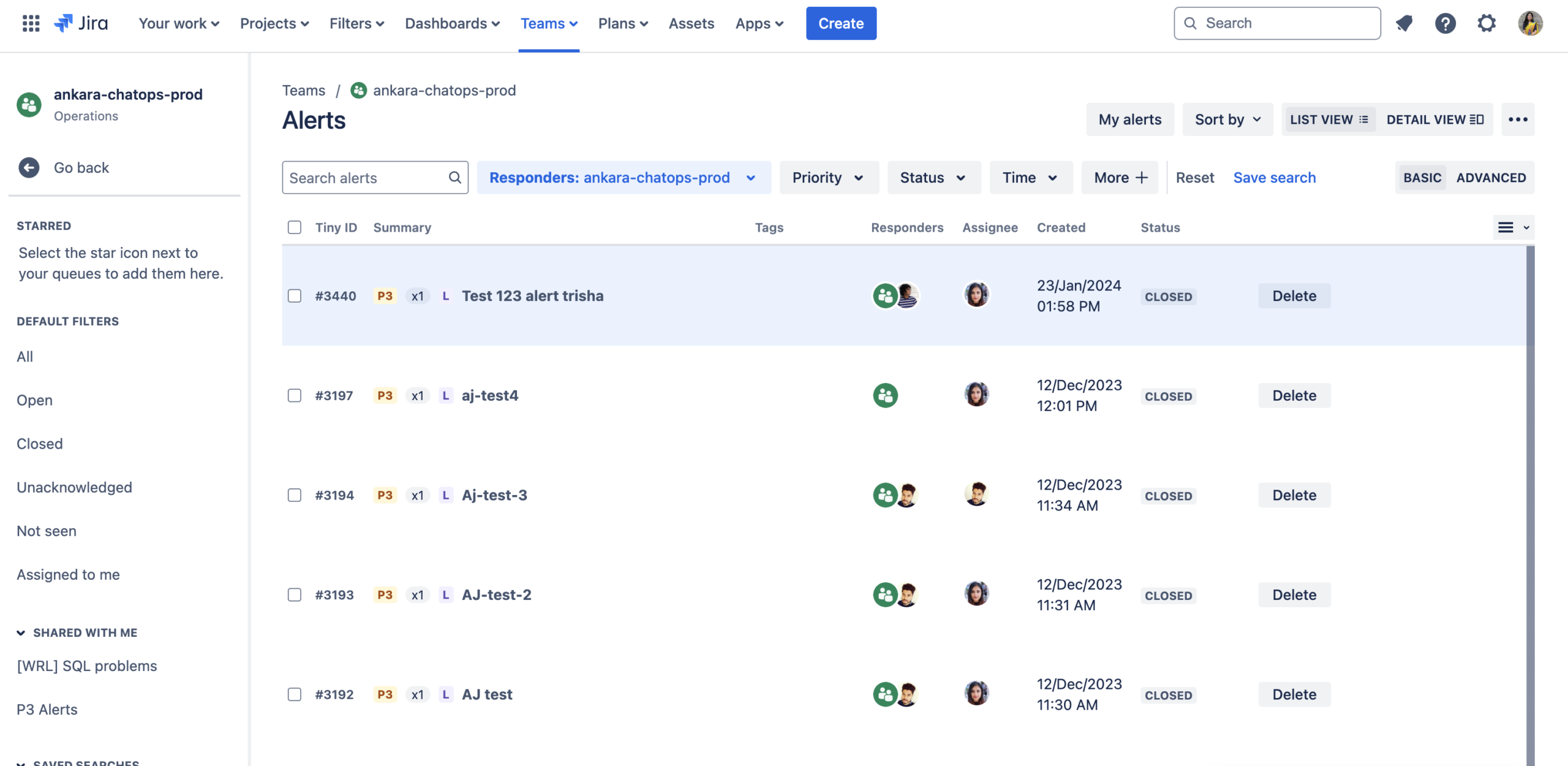
Before grouping, on-call engineers faced long, cluttered queues where critical incidents mixed with repetitive noise. Every alert demanded at least a quick look, often a full open, just to confirm it was not unique. This raised cognitive load as engineers repeatedly scanned titles and payloads to check whether the system was saying anything new, while the volume of similar alerts made it harder to spot patterns or early signs of a larger incident.
AI alert grouping collapses similar alerts into a single, problem-level unit. Instead of seeing ten nearly identical rows in thirty minutes, engineers see one group that represents a recurring problem and treat it accordingly. Individual alert details remain accessible when needed, but responders spend less time on repetitive triage and more time understanding the underlying issue.
By shrinking the visual volume of repetitive signals and grouping them, AI reduces cognitive overload, restores a sense of control, and creates space for deeper diagnostic work for engineers.

- Turning scattered alerts into a single source of incident truth
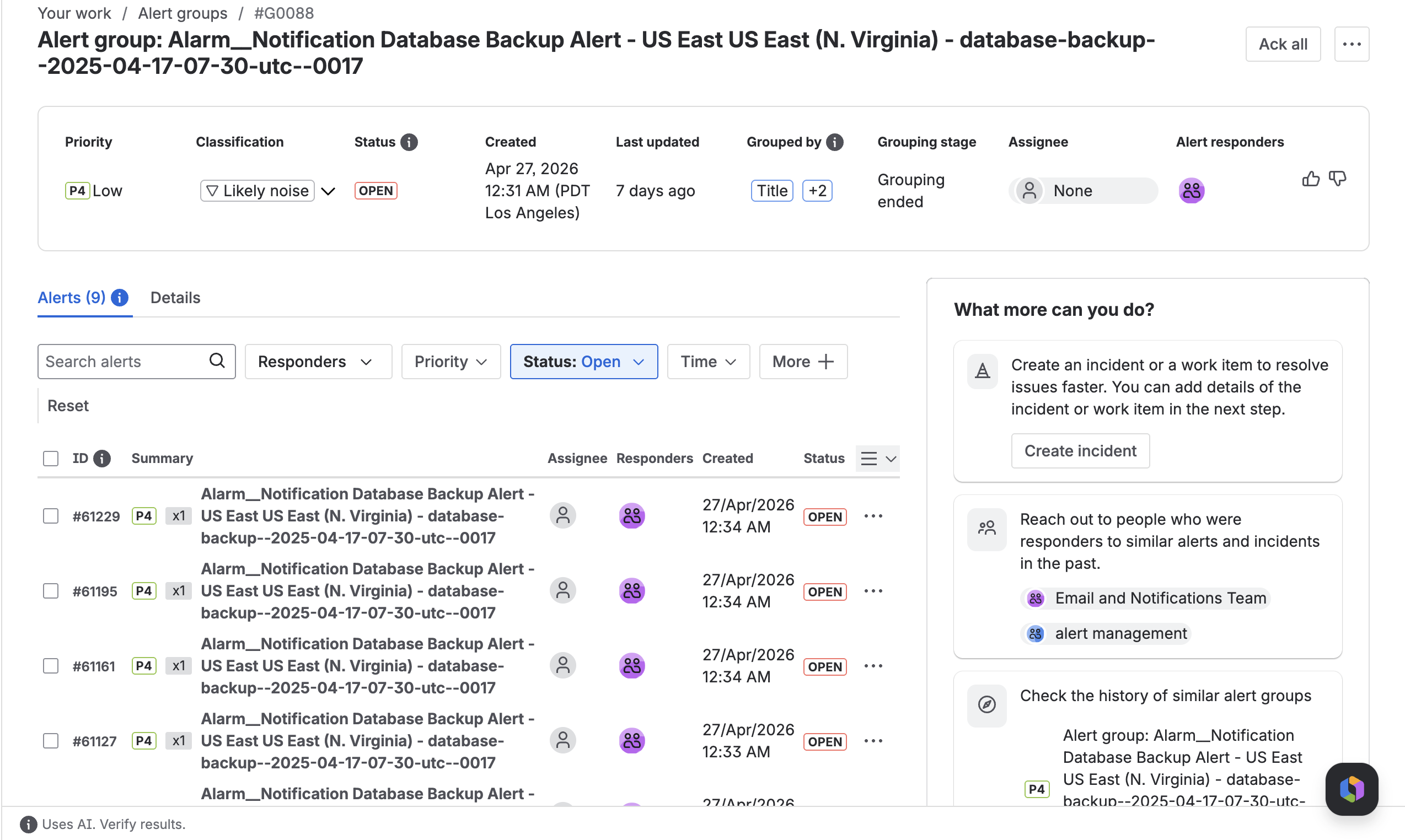
AI alert grouping does more than hide duplicates. It creates an organizing layer for incidents so engineers can work at the right level of abstraction. Each alert group acts as a container that preserves individual alert details while presenting a consolidated triage view: when alerts started, how often they fire, and which services or components they affect. Instead of stitching together a story manually across tabs, responders get a coherent picture in one place.
From this group view, they can take bulk actions such as acknowledging, closing, or escalating the group, eliminating repetitive clicks. When needed, they can still drill into individual alerts for deeper investigation or auditing.
That group preserves original alert details for analysis and compliance, highlights frequency, timeframe, and related services so responders can see scope at a glance, and makes the group, rather than individual alerts, the primary unit of work during incidents.
- Saving hundreds of hours with measurable productivity gains
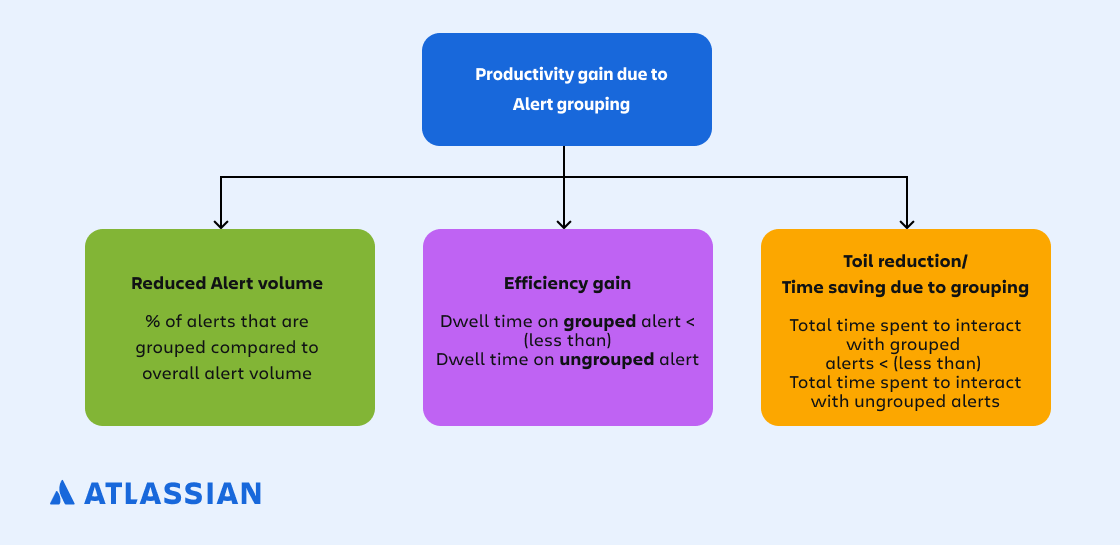
Atlassian measured how its engineers work with alerts before and after grouping, and the data shows substantial productivity improvements.
Over a 28-day period, AI-powered alert groups saved engineers 839 hours of work, roughly equivalent to the output of eight full-time engineers. Those hours were previously spent opening individual alerts, jumping between screens, and repeating the same triage steps.
For alerts that join a group, engineers spend an average of 59% less time on alert details. The reductions are especially striking for lower-priority alerts, where confirming impact is important but should not dominate on-call time.
Bringing AI-driven alert grouping to your own on-call team
The impact of AI alert grouping at Atlassian is ultimately about giving engineers their time and attention back. By collapsing duplicate noise into meaningful patterns, Jira Service Management helps teams see incidents as they really are: evolving problems to understand and resolve, not endless rows to click through.
The same foundations that support Atlassian’s on-call engineers are available to your team today. With Jira Service Management, you can:
- Connect alerts from the tools you already use and automatically group similar events into a single, actionable unit of work.
- Give on-call responders a consolidated view of what’s happening with the context they need to make decisions quickly.
- Reduce repetitive triage so engineers can focus on diagnosis, remediation, and long-term reliability improvements.
- Build on alert grouping with incident management, change management, and service request workflows in a single platform.
If you’re ready to cut through alert overload and give your on-call engineers a clearer, calmer way to respond, explore how AIOps in Jira Service Management can help — and if you need help crafting a tailored walkthrough for your on-call environment, feel free to reach out to an Atlassian specialist.