


Real-world customer stories of automated triage, translation, and incident follow-through.
Agentic automations in Jira Service Management are growing 3.4x faster than traditional automations. The reason is simple: teams aren’t just speeding up tasks anymore — they’re handing entire workflows to AI agents that triage, translate, investigate, and follow through on their behalf.

Three Atlassian customers — Axpo, SpotOn, and Vodeno — show what that looks like in production today.
Three teams. Three workflows. Zero hand-offs.
Axpo: end-to-end auto-translation for multilingual support
The problem: Axpo, a leading Swiss energy provider, serves German-speaking users from a second-level support team in Madrid that doesn’t speak German. Every ticket meant copy-paste into translation tools, waiting for results, and back-and-forth clarification.
The solution: With Rovo embedded into Jira Service Management, Axpo turned translation into a fully automated workflow. When a German ticket lands, Rovo detects the language, translates the summary and description into English, and stores it in a dedicated field. Every German comment is auto-translated and posted as an internal-only English note — original author and timestamp preserved.
Key outcome: Madrid agents now work every German ticket directly in Jira Service Management — no tool switching, no context loss, zero translation hand-offs.
How it works

| Trigger | Agent action |
|---|---|
| New German-language ticket created | Rovo detects language → translates summary & description → writes to custom field |
| New German-language comment added | Rovo translates comment → posts internal-only English version with original author + timestamp |
SpotOn: production ticket intelligence in a single view
The problem: SpotOn, a San Francisco-based restaurant technology and financial services provider, runs its internal IT support on Jira Service Management. Every request carries rich institutional context — past tickets, related docs, prior resolutions — but analysts had to hunt for it across tools every time a ticket landed.
The solution: SpotOn built a Rovo-powered agent that swarms each new ticket with sub-agents working in parallel. The moment a ticket is created, Rovo adds a single, context-rich comment containing a concise summary, similar past tickets, recommended next actions, a suggested assignee, and links to relevant docs.
Key outcome: Analysts open a ticket and everything they need to act is already waiting — faster first response, higher consistency, and AI-surfaced knowledge delivered the moment it’s needed.
How it works
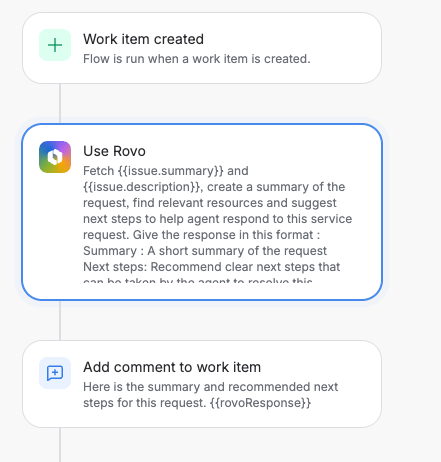
| Trigger | Agent action |
|---|---|
| SpotOn employee submits a support ticket | Rovo sub-agents swarm in parallel → add a single enriched comment with: summary, similar tickets, recommended next steps, suggested assignee, relevant docs |
Vodeno: from incident diagnosis to automated PIRs
The problem: Vodeno, a European banking-as-a-service platform, needed to compress the full incident lifecycle — from diagnosing root cause to capturing learnings and ensuring follow-up work actually got done. Manual investigation and post-incident documentation were slow, inconsistent, and easy to deprioritize once the fire was out.
The solution: Using the Rovo Ops agent with Jira Service Management automation, Vodeno now runs the whole lifecycle as a single agentic workflow. On incident creation, Rovo Ops analyzes context and proposes the most probable cause. On resolution, Rovo creates the PIR in Confluence, links it to the incident, extracts follow-up actions, and creates Jira tasks to track them.
Key outcome: Faster diagnosis, consistent post-incident reviews, and zero missed follow-ups — every incident now hardens the system instead of just closing a ticket.
How it works
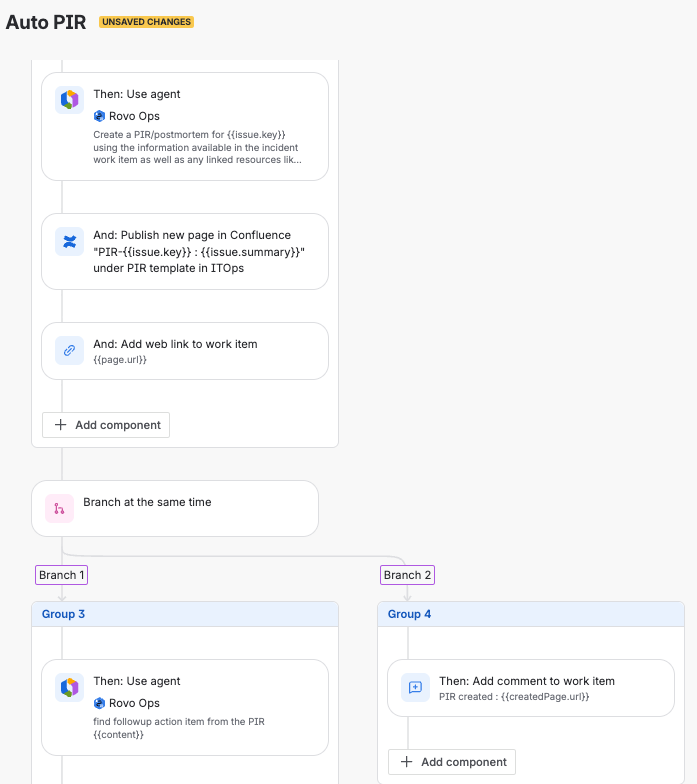
| Trigger | Agent action |
|---|---|
| Incident created | Rovo Ops analyzes context → shortlists likely causes → updates the incident with the most probable cause |
| Incident resolved | Rovo creates a PIR in Confluence → links to the incident → extracts follow-up actions → creates Jira tasks |
The pattern: human hand-offs replaced by agentic hand-offs
Across all three stories, AI is not replacing humans — it is eliminating hand-off and friction. Axpo removed the translation friction. SpotOn removed the context-gathering hand-off. Vodeno removed the post-incident documentation and follow-through hand-off. Each one freed humans to focus on the work that actually needs a human.
That’s why agentic automations are growing 3.4x faster than traditional ones: they don’t just shave seconds off a task like traditional automation does — they delete entire steps from the workflow.

Try it yourself
Your team’s next breakthrough might be one automation away. Explore the new Jira Service Management automation templates using Rovo — pre-built starting points for triage, translation, incident response, and PIR generation.


